
Who owns Maui’s coqui belt?
Government agencies and just 12 large landowners control 76% of Maui’s potential coqui habitat. They have a lot to gain from stopping the spread — and a responsibility to help fund the fight.
October 24, 2026 · Tim Storm
Maui’s coqui problem is often treated as a neighborhood problem.
Homeowners are asked to spray their yards, trap frogs, work with neighbors, and do their part to stop the spread.
But here’s something worth considering:
76% of Maui’s potential coqui habitat belongs to government agencies and just 12 large landowners.
That’s roughly 152,000 acres controlled by a relatively small number of entities.
Much of that land may still be free of coqui.
So while Haʻikū residents struggle to control an infestation already surrounding their homes, there’s a much bigger question:
Who is investing in keeping the rest of Maui from becoming the next Haʻikū?
What is the coqui belt?
Coqui need two things Maui has plenty of: warmth and water.
Below about 4,200 feet, where annual rainfall is at least about 40 inches, conditions may allow coqui to live and breed without anyone watering the land.
For this analysis, we’re calling that area the coqui belt.
On Maui, it covers approximately 199,459 acres, or 43% of the island.
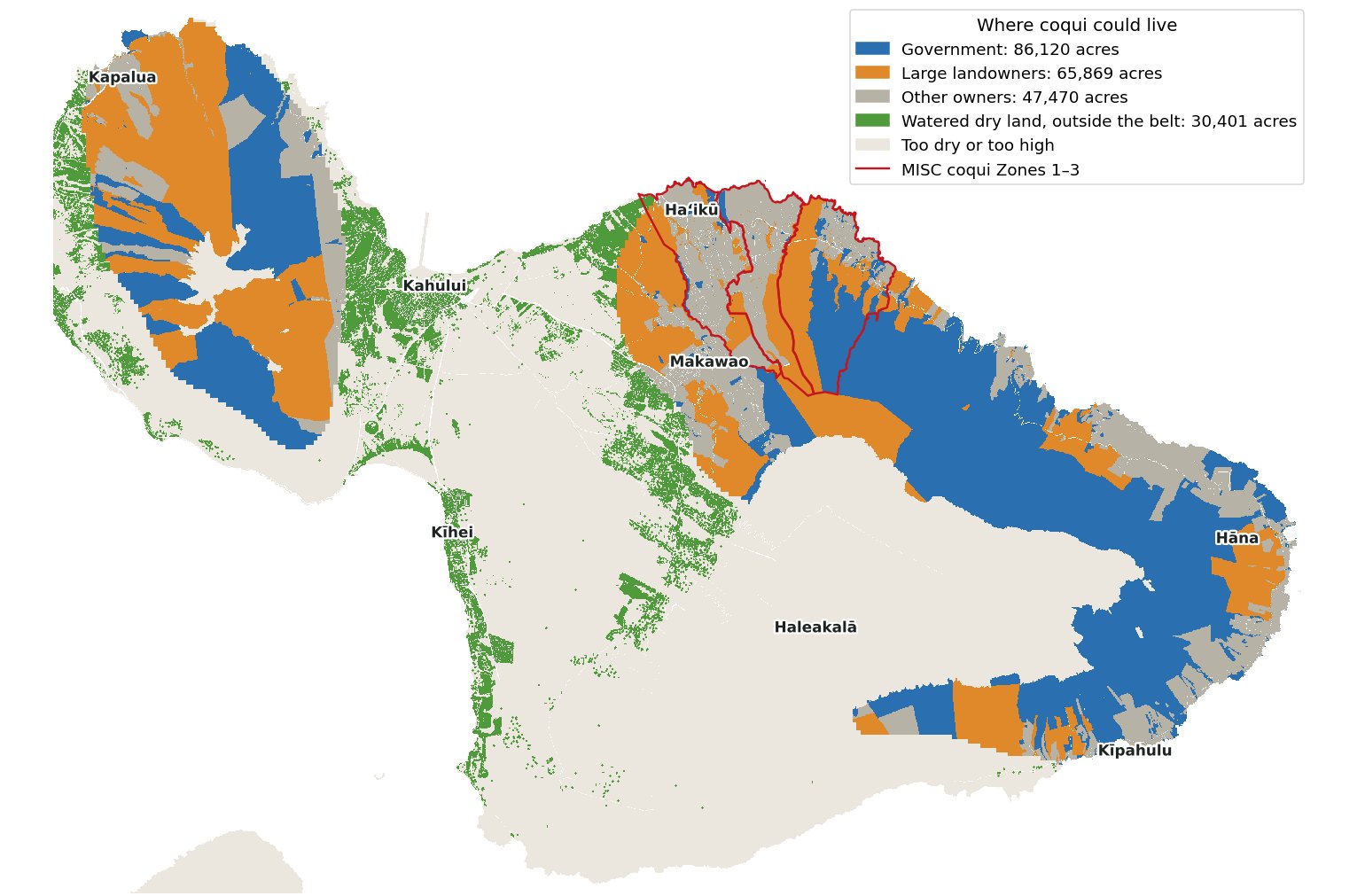
This is land where coqui could live, not necessarily where they live today. Where coqui have been heard or reported is on the map.
Using Maui County property records, here’s who owns that land:
The largest landowners include the State of Hawaiʻi, Maui Land & Pineapple, East Maui Irrigation, Mahi Pono, Kamehameha Schools and several major ranches.
The map and ownership breakdown below show just how much potentially suitable habitat is in relatively few hands.
| Owner | Acres in the coqui belt | Share |
|---|---|---|
| State of Hawaiʻi | 71,347 | 35.8% |
| United States (federal) | 8,643 | 4.3% |
| County of Maui (with the Board of Water Supply) | 6,130 | 3.1% |
| Government | 86,120 | 43.2% |
| Maui Land & Pineapple | 17,341 | 8.7% |
| East Maui Irrigation | 11,221 | 5.6% |
| Mahi Pono (MP LLCs) | 8,077 | 4.0% |
| Hanaula Ranch | 6,986 | 3.5% |
| Kamehameha Schools | 5,440 | 2.7% |
| Haleakalā Ranch | 3,900 | 2.0% |
| Hana Ranch | 3,535 | 1.8% |
| Wailuku Water Company | 2,599 | 1.3% |
| Kāʻanapali Land | 1,913 | 1.0% |
| Makila Land Co | 1,674 | 0.8% |
| Nuʻu Mauka | 1,596 | 0.8% |
| East Maui Landholdings | 1,587 | 0.8% |
| Large landowners | 65,869 | 33.0% |
| Other: every owner with less than 1,000 acres in the belt | 47,470 | 23.8% |
| The coqui belt | 199,459 | 100% |
Watered land is vulnerable too
The coqui belt is only the land that rain keeps wet enough.
Coqui can also live in dry places where people water the land. Every earlier coqui population found in Kīhei, Wailea, Kāʻanapali, Kapalua and Kahului was in a nursery, a resort or other watered land in a dry area. All were eradicated, but they show that frogs don’t need the belt to survive.
Outside the belt, about 30,400 more acres of Maui are watered: neighborhoods, resorts, nurseries, golf courses, parks and irrigated fields. They are shown in green on the map.
These areas aren’t contiguous. They’re scattered pockets. But each one is a place where a frog arriving on a plant, a truck or a piece of equipment could start a new population.
Together with the belt, that’s about 230,000 acres, nearly half of Maui, where coqui could live.
| Watered acres | Homes, resorts | Fields, golf | Total |
|---|---|---|---|
| Government | 1,120 | 1,943 | 3,063 |
| Large owners | 307 | 4,926 | 5,233 |
| Other | 16,951 | 5,154 | 22,105 |
| Total | 18,378 | 12,023 | 30,401 |
Most of the watered land belongs to homeowners and businesses. That’s where early detection matters most. If you hear a coqui in a dry part of Maui, report it.
Why this matters
Today’s major coqui infestation is centered around Haʻikū and Māliko Gulch.
But the conditions that allow coqui to thrive extend well beyond Haʻikū, through East Maui’s forests, farms, ranches and watersheds, all the way to Hāna and Kīpahulu.
Much of this land is still worth protecting.
The frogs don’t need roads, houses or property owners to spread. Dense, wet vegetation provides plenty of places for them to live and breed.
And once coqui become established across large areas of difficult terrain, controlling them becomes extremely expensive, if it’s even practical.
A homeowner might be able to keep a quarter-acre yard quiet. That same homeowner has little hope of controlling frogs living hundreds of feet down a steep gulch.
Now imagine trying to manage thousands of acres of those conditions.
This isn’t just a map of land where coqui could spread. It’s a map of what Maui still has an opportunity to protect.
And protecting that land starts by containing the infestation we already have.
Containment is an investment, not a favor
This is where the ownership numbers become important.
If government agencies and large landowners control three-quarters of Maui’s potential coqui habitat, they have an enormous stake in preventing the infestation from reaching that land.
Helping contain coqui in Haʻikū isn’t charity for Haʻikū residents.
It’s an investment in protecting the rest of Maui.
Every infestation stopped at its current boundary is one less opportunity for coqui to spread into new areas.
Every isolated population found and eliminated before it grows is land that may never need a large-scale treatment program.
And every acre reclaimed from an established infestation may help reduce the pressure on neighboring properties.
The benefits don’t stop at property boundaries.
This is especially true for government agencies. Public funds spent on containment today can help protect public lands, natural resources, and communities that may otherwise require much more expensive treatment in the future.
There’s also a cost to doing nothing.
As coqui spread, the area needing treatment grows. More properties become involved. More difficult terrain becomes infested. And the work becomes harder.
The cost of containment doesn’t stand still while we decide whether to fund it.
Where is the long-term plan?
Maui has spent years fighting coqui. MISC, community groups, and individual residents have put enormous effort into the problem.
But Maui has never committed the sustained funding needed for a long-term effort that matches the scale of the infestation.
Instead, limited resources have forced difficult choices about where treatment can happen and where it cannot.
Residents are left trying to manage what they can, often while frogs continue breeding on nearby land they cannot access or treat.
We need more than an ongoing collection of individual efforts.
We need a funded, long-term plan with clear goals:
- Find the current boundary. Regular surveys to determine where coqui are present and where land remains quiet.
- Hold the line. Stop the infestation from expanding into new areas.
- Push the line back. Target places where treatment can reduce the existing infestation, not just slow its growth.
- Stop new outbreaks. Detect and eliminate isolated populations before they become established.
- Fund the work for the long term. Provide dependable staffing, equipment, treatment capacity and monitoring instead of relying on uncertain short-term funding.
- Measure and share progress. Show residents and funders where the effort is working, where it isn’t, and what needs to change.
This isn’t a proposal to spray all 199,459 acres of potential habitat.
It’s a proposal to protect those acres by investing in the much smaller area where containment and treatment can make a difference.
And that requires a real commitment, not just encouragement for residents to do more.
Kuleana means sharing the responsibility
Residents are being asked to take responsibility for their properties.
Treat your yard. Work with neighbors. Report frogs. Don’t let them spread.
That’s reasonable. Many residents have already invested considerable time and money doing exactly that.
But why should responsibility stop with those homeowners?
Government agencies have a responsibility to protect public lands and resources. Large private landowners have a stake in protecting their properties. And both have resources and opportunities that individual homeowners generally do not.
Their contribution doesn’t have to look like a homeowner walking around with a backpack sprayer.
It might mean funding treatment crews, providing equipment, granting access, conducting surveys, supporting research, or helping finance a coordinated containment program.
For government, it means recognizing coqui containment as a long-term public investment deserving a dependable budget.
For major private landowners, it means helping protect the land they own and the surrounding areas that put their property at risk.
And for residents, it means continuing to do what they can on the ground.
Different resources. Different roles. Shared kuleana.
The point isn’t to assign blame for how we got here.
It’s to recognize that the responsibility for what happens next belongs to more than the people who happen to live in the middle of the infestation.
We need to know where the line is
One of the biggest challenges is knowing exactly where coqui are today.
Not just where they’ve been reported, but where they haven’t been heard.
That’s part of why I built MauiCoqui.com.
The site allows residents to report frogs on their properties, but just as importantly, to report that they’ve listened and their property is quiet.
I’ve also been conducting road surveys to find areas where frogs are being heard and areas that remain quiet.
A quiet report doesn’t guarantee there are no coqui. But it helps us identify places worth checking and protecting.
That information can help guide a larger containment effort.
If we want to hold the line and eventually push it back, we first need to know where it is.
And we need to keep checking, because the line doesn’t stay in one place.
The cost of waiting
Maui still has a choice.
We can continue relying on homeowners, volunteer groups and limited treatment programs to manage a growing problem.
Or we can make a serious, long-term investment in containment, with government, large landowners and residents contributing to a shared effort.
The longer we wait, the farther coqui can spread and the more expensive the job becomes.
We don’t have to eliminate every frog on Maui to make meaningful progress. Protecting quiet areas, stopping new outbreaks, holding the boundary and pushing it back where possible would all be meaningful victories.
But none of that happens without sustained resources.
The people fighting coqui in Haʻikū aren’t just protecting their neighborhoods. They’re helping protect the rest of Maui.
It’s time for the agencies and large landowners who have so much to protect to help fund that effort.
Not as a favor to Haʻikū, but as an investment in Maui’s future.
Residents are being asked to do their part.
Funding and carrying out a long-term plan is part of the government’s and major landowners’ kuleana, too.
And every year we put it off, the job gets bigger.
Methodology: The coqui belt includes land at or below 1,280 meters (about 4,200 feet), with mean annual rainfall of at least 1,000 mm (about 39 inches). These limits use the highest coqui elevation recorded in MISC’s 2019 Coqui Management Plan and rainfall data from the Rainfall Atlas of Hawaiʻi (2013). Elevation data comes from USGS 3DEP.
Watered land is counted separately and is never added to the belt. It is drier land within about 60 meters (200 feet) of a County address point (homes, resorts, nurseries and businesses), plus mapped golf courses, parks, fields, orchards and nurseries (OpenStreetMap) that stayed green through the June–October 2026 dry season in Sentinel-2 satellite images (25th-percentile NDVI of at least 0.5). It is an estimate from maps and satellite images, not a survey. Mapped land is required because natural kiawe forest and cool upland slopes also stay green without water.
Ownership comes from Maui County’s 2026 certified real property roll and 2024 property boundaries. Acreage figures are estimates, not surveyed measurements. Owner names are grouped as recorded in the property roll. The “Other” category includes owners with less than 1,000 acres in the belt, the Department of Hawaiian Home Lands (948 acres), and parcels where only a lessee is listed. Ownership and land-management responsibilities may differ.